


The Vanished Obelisk


The object data of Diablo II still contains a set of interactive objects named Obelisk. They are not mere scenery: the object functions, a dedicated interface and the reward data all indicate that this was once a wilderness random event which used gems as its medium and granted permanent character upgrades.
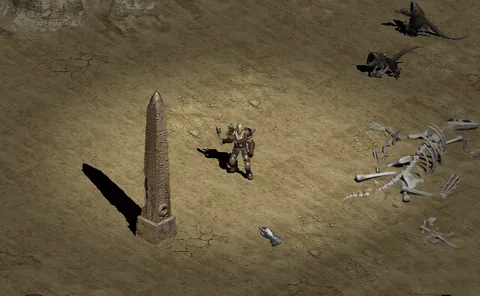
The Obelisk that still ships with the game
The data confirms at least two related objects:
- Obelisk: object ID 80
- Desert Obelisk: object ID 90
Both use the SubClass value 2, the field that declares which category an object belongs to so that the init, operate and populate functions know how to treat it. The desert variants use the tokens AO and DO, which both resolve to the same desert obelisk appearance.
What the object functions reveal about the original purpose
Field values and their meaning: OperateFn 17 — opens the trade interface and operates the obelisk while the player carries a gem; PopulateFn 3 (ID 80) / 2 (ID 90) — controls how the object is placed in the area. The meaning of OperateFn = 17 is unambiguous: the trade interface is only allowed when the player's inventory holds a gem. Without one the interface never opens; with one, the socket in the centre of the stone lights up.
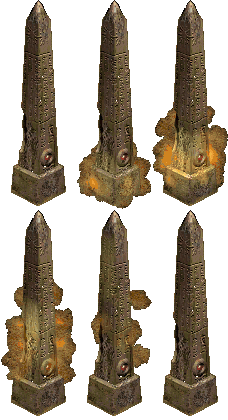
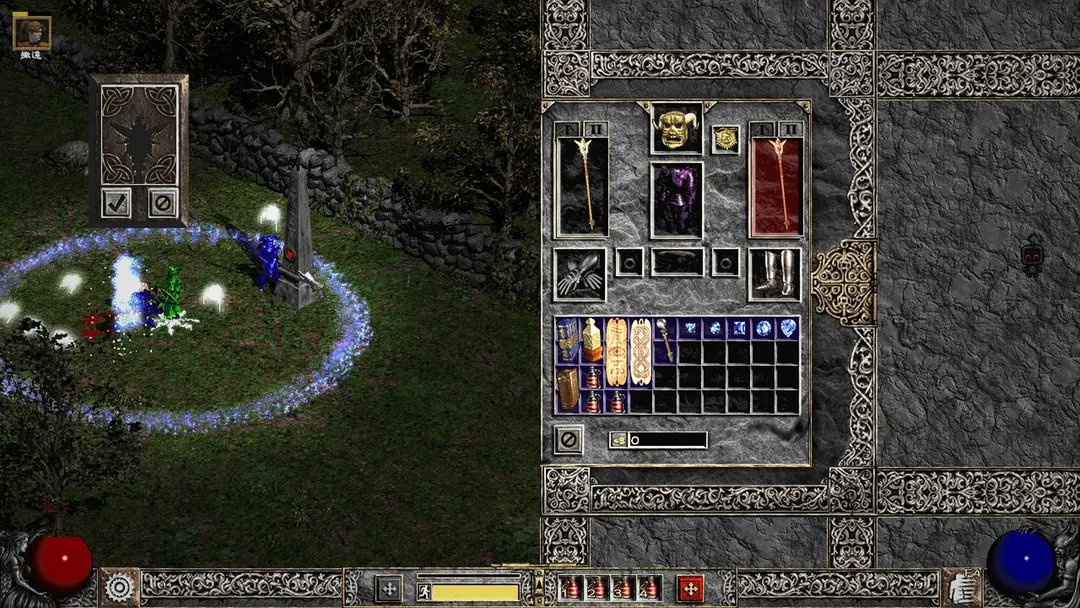 The insertion interface as it triggers in the shipping build, and the obelisk after a Horadric Staff has been placed inside.
Why only the Horadric Staff goes in now
The interface the obelisk currently calls is clearly shared with — or has been replaced by — the Act II receptacle for the Horadric Staff. In testing the staff does go in: the obelisk plays its animation once and then becomes permanently uninteractable; the red socket in the centre stays lit, but nothing further happens.
The gem the original design asked for, on the other hand, cannot be inserted at all. This looks like the residue of interaction logic that was rewritten during development: the object and part of its interface survived, but the code entry point had already been redirected to the Horadric Staff flow.
The abandoned reward system
The leftover data points to a reward that permanently raises character stats. Each subtype maps to maximum Mana, one of the four core attributes, maximum Life or skill points, and each keeps its own success rate.
| subtype | Effect | Success rate | Amount |
|---|---|---|---|
| 0 | maximum Mana | 100% | +1 |
| 1 | maximum Mana | 100% | +1 |
| 2 | maximum Mana | 100% | +2 |
| 3–5 | Energy | 5% / 10% / 15% | +1 |
| 6–8 | Dexterity | 5% / 10% / 15% | +1 |
| 9–11 | Vitality | 5% / 10% / 15% | +1 |
| 12–14 | Strength | 5% / 10% / 15% | +1 |
| 15 | maximum Life | 100% | +1 |
| 16 | maximum Life | 100% | +1 |
| 17 | maximum Life | 100% | +2 |
| 18–20 | skill points | 3% / 6% / 10% | +1 |
The table covers Mana, the four core attributes, Life and skill points, together with the success rate attached to each.
Nothing in the retail game's permanent-reward system corresponds to this directly. Retail growth is handed out in fixed amounts through quests:
- Akara: 1 skill point
- Radament: 1 skill point
- Rescuing Anya: 10 resistance
- The Golden Bird: 20 Life
- The Book of Lam Esen: 5 attribute points
- Izual: 2 skill points
So the Obelisk was most likely an attempt to fill the niche of "a wilderness random event that grants permanent growth". The success rates on the rewards also fit Diablo's habit of building its feedback loop around randomness.
What a restoration has to solve
- Restore the missing subtypes in the
miscdata. - Change the client logic: accept a gem, reject the Horadric Staff.
- Supply the activation loop plus the success and failure sounds.
- Add explicit text telling the player which reward was granted.
- Decide whether the Obelisks in other acts need their own appearance.
The original numbers are not fit to ship as they are. Once permanent attributes and skill points can be farmed repeatedly, the character growth curve collapses almost immediately.
A more reasonable balance pass
Two routes are worth considering:
- One permanent reward per difficulty. Keep the random success rate but rebalance the amounts; this stays closest to the traces of the original design.
- Turn it into a Shrine-like temporary buff. Lower risk, but it loses the one thing that separates the Obelisk from an ordinary Shrine.
The first route is the better one. Capping the payout to once per difficulty preserves the novelty of stumbling onto a permanent upgrade in the wild, prevents infinite farming, and keeps the randomness that mattered most in the original design.
Conclusion
The Obelisk is not an empty shell with a name attached. The object IDs, the SubClass value, the operate function, the trade interface, the model's lit socket and the reward table corroborate one another and assemble into a fairly complete piece of cut content: the player finds an obelisk in the wilderness, feeds it a gem, and rolls for a permanent upgrade. The Horadric Staff logic of the retail build took over its interaction endpoint without ever erasing the traces of the system underneath.
Historical reference: archived DiabloII.net Shrine documentation. The restoration and balance proposals above are inferences drawn from the surviving data and in-game testing.
THE TRAVELLERS' LEDGER
The Travellers
These travellers have fed the campfire at Rogue Encampment.
List last updated · 2026-10-24 15:43
 *屑
Sponsored 2×
 *z
 *呀
 L*A
 *手
 *了
Sponsored 2×
 *铭
 *空
 p*e
 月*M
 T*g
 m*n
Support the Encampment
Support
Rogue Encampment is a cut-content archive I built out of respect for a great work and out of sheer love for it. Sorting material, researching cut content, restoring mechanics, keeping the site running — every part of it takes longer than farming Mephisto runs.
If you found something interesting here and would like to support me digging further, or simply feel like buying me a drink, you can add a log to the campfire and keep it burning.
Your support goes towards:
- Keeping the server and domain alive
- The time that goes into gathering material, research and video production
- A drink, or a hotpot
- My late-night and insomnia subsidy
Everyone who supports the camp gets written into the Travellers' ledger beside the campfire. Thank you!


中If it permanently adds to the panel, rolling a high value would feel great to play
中Your proposed solution 1 is both sensible and practical. Thinking back to the years when the internet was not widespread: a Black Tower Key would drop and I never had any idea what it was for. In fact, even now I still have not worked it out.
中It is useless now — it used to open Mephisto's Black Tower
中121
中111