

Battle.net Village, Guilds, Arenas — Documentation 1 (Stay Awhile and Listen, Book II)


I. Battle.net Town
1. Chapter epigraphs — three lines that set the tone
This chapter opens with three epigraphs that pin down the core tension of the Battle.net chat room / town design:
"We weren't exactly sure how it would work, but basically we wanted to skip the chat room and make a real environment."
— Dave Brevik, co-founder, Blizzard North
"We had big arguments over, when you're in the Battle.net chat room, are you your account, or are you your character?"
— Max Schaefer, co-founder, Blizzard North
"People would come in before their characters were loaded, and as soon as they would show up on my screen I would kill them dead."
— Cheeming "Amigo" Boey, artist, Blizzard North
2. Origins — Dave Brevik's vision of a shared public space
The chapter opens by setting the scene: Tristram in the first Diablo was little more than "a one-horse town", and although the four towns of the sequel were grander, the Blizzard North team still imagined a much larger gathering place for the reworked multiplayer experience.
"For a long period of time, what I really wanted to do was a Battle.net town where you'd be dumped into the game, a public space, where you could do trading and chat and stuff," Dave Brevik said.
3. Concept art — Kris Renkewitz's grand plan
Kris Renkewitz drew concept art for a bustling online settlement. "I laid out this massive thing. They patted me on the back in front of the entire company. It was this incredible moment."
4. Abandoned — the obsession with "getting players into the game as fast as possible"
Dave Brevik dropped the online town for practical reasons.
"The number-one reason we got rid of Battle.net Town was really Dave's focus—rightfully so—on making sure people got into the game as quickly as possible," explained Mike Scandizzo, programmer. "Minimum number of clicks to bring you into the game, and realizing that walking around in a town to get where you need to go was going to slow us down."
5. The compromise — a character gallery along the bottom of the screen
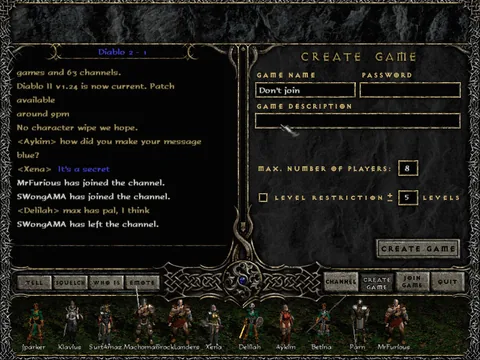
The developers compromised by restructuring Diablo II's Battle.net interface. It still consisted of a chatroom and buttons to begin and join sessions, but a gallery was added to the bottom of the screen that displayed the avatar of every player in the chatroom.
"I did all the Battle.net [character representations]," Jon Morin said. "The cool part about that was you could see your character in the chat room. So, you'd go into Battle.net and people would see what he looks like, saying, 'Wow, that guy has everything.'"
6. Further scale ideas — something like Lut Gholein, holding around fifty people (sidebar [SQ1])
"I think there were going to be NPC merchants as well," added Erich Schaefer. "It was going to be kind of like the town of Lut Gholein: All the players, maybe up to fifty people, would be going in and out of games from there. That's kind of the size I imagined in my head."
7. Status — never more than sketches on paper
Battle.net Town never progressed further than sketches on paper. While later online games would add functional locations and vendors such as auction houses where players could bid on items using real or in-game currency, and banks where they could deposit gold once their character's inventory was full, Diablo II's developers thought of the online hub as more of a visual representation of the original Battle.net chat room.
8. Technical limits — memory and production cost (Phil Shenk)
Technical restrictions cropped up as well. "The biggest reason for doing that was memory," said Phil Shenk. "To have that many characters on screen at one time, all wearing components—it was not really going to be feasible. It would have taken a lot more time, too."
9. Hindsight — the MMO era, and the cost/benefit calculation (Pat Wyatt, later of Guild Wars)
"All the MMOs have taught us things in later years," added Pat Wyatt, vice president of research and development at Blizzard Entertainment. "If you ever played Guild Wars, which I worked on, and you want to form a party when the game launched, you sort of run around and yell, 'Hey everyone! LFG [Looking for Group] Warrior Level 51, looking for monk, looking for healer.' It's kind of chaotic. That stuff can work, but you've got to spend a lot of effort building something like that. Does that effort extend to other games? Or you've done all that work for Diablo and it's not useful for any other game?"
10. What survived — the core pursuit of multiplayer
Scrapping Battle.net Town did nothing to dissuade Blizzard North from Diablo II's core focus. Doing away with the cheating that plagued Diablo had been a major impetus for moving on to a sequel.
"The guys at Blizzard North and at Blizzard South played Diablo online almost exclusively," Erich Schaefer recalled, "so we said, 'Let's keep making the game we want to play,' and we wanted to play multiplayer."
The team would architect it as a client-server game: Players, the clients, had to connect to servers that functioned as gatekeepers, checking for unsavory actions such as duplicating items and using hacks to kill other players in safe zones.
11. The argument — "are you your account or your character?"
That argument directly decided the final shape of the Battle.net UI and chat room:
For months, Blizzard North asserted that players should be represented in Battle.net by their character name. Blizzard South disagreed, preferring to streamline the login interface across all Battle.net-compatible games and require users to log in with an account. "We argued that that was putting the cart before the horse," said Max Schaefer. "We felt that Battle.net was just a matchmaking service to put players in games, and that no one cares about it so much, they just care about whether or not the games work. They don't care that they're in an experience called Battle.net, it's just the way they interface with other people."
Compromise won the day. Players logged in with an account, and then proceeded to select their character. Once they joined a Battle.net chatroom, their character and name were displayed along the bottom of the interface courtesy of Jon Morin's code.
"That actually went on for weeks, that sort of debate. The design of that whole interface was what we were concerned with more than beta testing and that sort of thing, which was handled down south," Max continued.
12. Battle.net in the first Diablo — the forerunner of the Battle.net town
This is what the "town / chat room" gathering place looked like in the first game:
Through Battle.net, Diablo built bridges across continents. To jump online, all players needed to do was create a character, click a button to connect to Battle.net, and they were whisked into a chat room where other adventurers gathered. From there, players could create or join a game session.
"We believed that in order for it to really be embraced and adopted, that accessibility had to be there," Jeff Strain said of Battle.net. "The real catch for Battle.net was that it was inside-out rather than outside-in. You jumped right into the game. You connected players from within the game experience. You did not alt-tab off into a web browser to try to set up your games..."
For a solid week, Blizzard North's staff lived on Battle.net. They mingled in channels, jumped into games to help players recover lost items, and filled their packs with treasure that fountained up from Diablo's bottomless well of procedurally (or algorithmically) generated loot.
13. Related — town safe zones and the PvP ecosystem on Battle.net
The Battle.net town was cut, but "the town is a safe zone" remained a key part of multiplayer in both the first game and Diablo II:
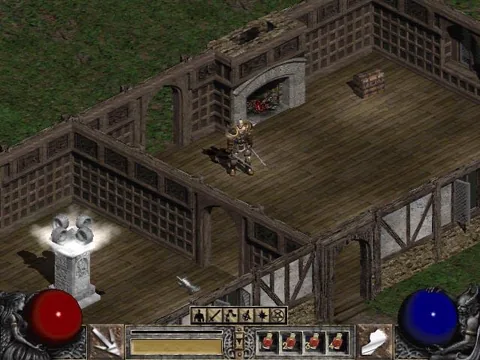
Weapons and spells were deactivated in Tristram so players could shop and manage their inventories in peace. If an ally turned hostile, players who chose to abstain could open a town portal and flee to the sanctuary of Tristram.
Within months, Battle.net became a town under curfew. Cautious players locked game sessions by setting passwords that they only handed out to friends, or to no one. Public games had become places for hackers to pillage and plunder.
Fighting was forbidden in Tristram—unless unsavory players hacked their game—but with a single click of the Hostile button, one player could turn on another without warning down in the dungeons. The Hostile button returned in Diablo II, but could only be activated in town. Players had to reach a certain level of experience before they were allowed to attack others. When one player went hostile, all other players received visual and audio warnings.
"I felt that our reasons for increasing player-killing pre-requisites was a philosophical thing," said Erich Schaefer. "There was a huge school of thought that you should never allow player-killing because the loser is going to be mad and we wanted to make a fun game for everybody."
14. Related — the death-and-return-to-town mechanic (and how Boey weaponised it)
"You respawn in town" is exactly the role towns took on in multiplayer after the Battle.net town was cut — safe, yet quietly dangerous:
After ambushing someone just outside of town, he would stand over their body while the player revived in town. "At this point, I couldn't loot their body yet," said Boey, explaining his setup. "But when you die, you spawn inside the town, and all your items are left on your corpse. So when you go collect your stuff, that's when all your gear goes back on your character."
15. An Oral History of Diablo 2
Years later, whenever the developers were interviewed about the Battle.net town, they spoke of it with regret.
David Brevik: One of the things that we wanted to do that never got done in Diablo II was that we were trying to design this thing called Battle.net Town. You know, my idea was to get into a world, and you don’t leave the world. I wanted to try to break that reality, break that illusion that we’re not in a contiguous world. I wanted you to start in that world, not start in the Battle.net chat lobby, but start in that world. And Battle.net Town was going to be a glorified chat room where you could move around, but you could still go to the pub and chat with people, or go to a vendor, and then you would go to a specific person and you would travel to Act 1.
So, you never left the world, and that was kind of one of the things that didn’t make it, but that was one of the things that we wanted the most, that I personally wanted the most, which was, I really wanted this kind of, more of an immersive world feeling to the game than we had, and make it more expansive. We’re not just in the dungeon beneath this town, that there’s a big world out there.
II. Guilds
1. [Core] Diablo II: Salvation — the Guild Castle and the MMO-leaning expansion (sidebar [SQ6])
This is the book's most substantial passage on guilds. The cancelled second expansion for Diablo II was tentatively titled Salvation, and was meant to introduce Battle.net-focused, MMO-style features:
According to Dave Brevik and other developers, a second Diablo II expansion was considered, but ultimately tabled in order to move on to Diablo III. The expansion, tentatively named Diablo II: Salvation, would have introduced another new character class and features geared toward Battle.net.
"What I'd wanted to do with Diablo III, and what we should have done with Diablo II—which we actually did, and then it got cancelled—we were going to have another expansion that was going to introduce more MMO-like features," added Dave Glenn. "Like being able to have a guild castle to spend money on and upgrade. You could join a game that had just your castle and some surrounding lands. You still played the game as you normally did in Battle.net, but then you'd have a home base to spend money on, and store and trade goods between your clan."
"One of the classes for the second expansion was a healing class, a cleric," said Dave Brevik. "We wanted an anti-undead cleric class... It was mainly a multiplayer class. It allowed for healing based on people's damages and things like that."
2. [Core] The Guild Hall prototype — the "Steeg Stone" gold leaderboard
Dave Glenn had even built a prototype of the Salvation Guild Hall. This is the book's most concrete description of how guilds would have worked:
Glenn had progressed so far as building prototypes for Salvation Guild Halls before it was shelved. "We were going to have a depository in your Guild Hall where you just throw in [gold] and there's a leaderboard that shows who has the most gold. It was called the Steeg Stone, after [designer] Stieg Hedlund. It was a model of a little guy. We'd try to out-earn each other and stuff. It was just a money sink, a deposit. You couldn't get the money out, but you'd just deposit your extra gold into it and try to get on the leaderboard. It was a super basic concept: for everyone in a group, would that be compelling, to keep adding to something? Because some people would say, 'Why would I spend money on something like that?' Well, just so you'd get [recognition]. That's why you do a lot of things. There's no logic to it, it's just a reward."
Salvation was cancelled due to growing excitement over what Diablo III could be. "We thought it would be kind of a grind to just start into the same stuff again, and that it was time to move on and do something else. For some people, that meant do something other than Diablo, whereas others were saying, 'Let's just do the next Diablo,'" said Max Schaefer.
3. Related — the "home base / mini-town" idea
The book mentions one other place where a home base is likened to a mini-town. It stands as supporting evidence for the Guild Castle (home base) concept — and it comes from a different, cancelled 3D space project:
"You had a spaceship that you flew around and served as a home base, kind of like a mini town," said Erich Schaefer. "You would land on a planet, go explore the planet, and then go find monsters and artifacts and stuff like that."
"As you went through the game you would level up your spaceship, add new features and space to it," Mike Dashow said. "So all the NPCs you have in your town in Diablo, you end up either having them in your spaceship, or as features on your spaceship."
III. Summary table
| Topic | Core content | Source |
|---|---|---|
| Battle.net Town | Dave Brevik's vision of a large public online town (trading and chatting), later cut and compromised into a character gallery at the bottom of the chat room; scale imagined at roughly 50 people, something like Lut Gholein; rejected because of "get into the game fastest" and memory limits | Chapter 19 body + sidebar [SQ1] |
| Guild Castle / Guild Hall | Diablo II: Salvation (cancelled): a guild castle you could upgrade with gold, a home base, inter-clan trading; the prototype included the "Steeg Stone" gold depository and a leaderboard | Chapter 19 and later chapters |
Appendix 1. Overview and status
According to Dave Brevik and other developers, a second Diablo II expansion was considered, but ultimately tabled in order to move on to Diablo III. The expansion, tentatively named Diablo II: Salvation, would have introduced another new character class and features geared toward Battle.net.
According to Dave Brevik and other developers, a second expansion for Diablo II was seriously considered, but was ultimately set aside to make room for Diablo III. This expansion, tentatively named Diablo II: Salvation, is described in the book as follows:
Appendix 2. The new class — an anti-undead Cleric
"One of the classes for the second expansion was a healing class, a cleric," said Dave Brevik. "We wanted an anti-undead cleric class. I can remember writing up the idea, and after I wrote it I said, 'Man, this would have been really fun.' It was mainly a multiplayer class. It allowed for healing based on people's damages and things like that. It wasn't direct healing, like, I'm standing back and healing everybody kind of thing. It was a very different style of gameplay. We'd actually gone through and made ideas and concepts and new tree entries for every class that would have been multiplayer-focused."
"One of the classes for the second expansion was a healing class — a cleric or priest," Dave Brevik said. "We wanted a cleric specialised against the undead. I still remember writing that idea down, and thinking afterwards: 'God, this would play well.'"
Appendix 3. The Guild Castle — MMO-style features
"What I'd wanted to do with Diablo III, and what we should have done with Diablo II—which we actually did, and then it got cancelled—we were going to have another expansion that was going to introduce more MMO-like features," added Dave Glenn. "Like being able to have a guild castle to spend money on and upgrade. You could join a game that had just your castle and some surrounding lands. You still played the game as you normally did in Battle.net, but then you'd have a home base to spend money on, and store and trade goods between your clan."
"What I wanted to do with Diablo III, and what we should have done with Diablo II — we did do it, and then it got cancelled — was put out another expansion with more MMO-like features," added Dave Glenn:
Appendix 4. The Guild Hall prototype — the "Steeg Stone"
Glenn had progressed so far as building prototypes for Salvation Guild Halls before it was shelved. "We were going to have a depository in your Guild Hall where you just throw in [gold] and there's a leaderboard that shows who has the most gold. It was called the Steeg Stone, after [designer] Stieg Hedlund. It was a model of a little guy. We'd try to out-earn each other and stuff. It was just a money sink, a deposit. You couldn't get the money out, but you'd just deposit your extra gold into it and try to get on the leaderboard. It was a super basic concept: for everyone in a group, would that be compelling, to keep adding to something? Because some people would say, 'Why would I spend money on something like that?' Well, just so you'd get [recognition]. That's why you do a lot of things. There's no logic to it, it's just a reward."
Before Salvation was shelved, Glenn had already built Guild Hall prototypes. "We were going to put a depository in the Guild Hall — you just throw gold into it, and there was a leaderboard..."
Appendix 5. The second expansion
Dave could not say much about the second expansion. [Information from source X]
it was only designed, never produced. I had a multi-page design doc going over new classes, new areas, new mechanics and story concepts. Not sure what I can say because Blizzard owns it.
Appendix 6. Why it was cancelled
Salvation was cancelled due to growing excitement over what Diablo III could be. "We thought it would be kind of a grind to just start into the same stuff again, and that it was time to move on and do something else. For some people, that meant do something other than Diablo, whereas others were saying, 'Let's just do the next Diablo,'" said Max Schaefer.
Salvation was cancelled because enthusiasm shifted to the possibility of Diablo III. "We felt that doing the same thing again would be a bit of a grind, and that it was time to move on and do something else. For some people that meant working on something outside Diablo; for others...
Blizzard filed a trademark application for Diablo II: Salvation with the USPTO on 26 April 2002. It was published for opposition on 11 March 2003, but after four extensions no statement of use was ever filed, and the application was finally abandoned in February 2006.
Appendix 7. Full inventory of information
| Item | What the book says |
|---|---|
| Name | Tentatively Diablo II: Salvation (never final) |
| Status | The second expansion for Diablo II (the first being the released Lord of Destruction) |
| Outcome | Shelved / cancelled because the team moved on to Diablo III |
| New class | Cleric — healing-leaning, anti-undead, multiplayer-focused, not a direct healer |
| Design depth | Ideas and concepts for new skill-tree entries were completed for every class (multiplayer-oriented) |
| MMO features | A guild castle upgradable with gold; castle plus surrounding land formed its own game room |
| Home system | The home base as a second space; storage and trading of goods between clans |
| Guild Hall prototype | A working prototype: Steeg Stone gold depository plus leaderboard; gold could not be withdrawn; purely reward-driven |
| Key people | Dave Brevik (cleric concept), Dave Glenn (Guild Castle and Guild Hall prototypes), Stieg Hedlund (the namesake), Max Schaefer (the cancellation decision) |
| Reason for cancellation | "Doing it again would be a grind"; enthusiasm moved to Diablo III; some people wanted a different subject |
THE TRAVELLERS' LEDGER
The Travellers
These travellers have fed the campfire at Rogue Encampment.
List last updated · 2026-10-24 15:43
 *屑
Sponsored 2×
 *z
 *呀
 L*A
 *手
 *了
Sponsored 2×
 *铭
 *空
 p*e
 月*M
 T*g
 m*n
Support the Encampment
Support
Rogue Encampment is a cut-content archive I built out of respect for a great work and out of sheer love for it. Sorting material, researching cut content, restoring mechanics, keeping the site running — every part of it takes longer than farming Mephisto runs.
If you found something interesting here and would like to support me digging further, or simply feel like buying me a drink, you can add a log to the campfire and keep it burning.
Your support goes towards:
- Keeping the server and domain alive
- The time that goes into gathering material, research and video production
- A drink, or a hotpot
- My late-night and insomnia subsidy
Everyone who supports the camp gets written into the Travellers' ledger beside the campfire. Thank you!

d2ga.net
中A folk version of the arena, haha A crowd of people drinking here
中I wonder what Blizzard North's Diablo III story would have been.
中This guild system and the Battle.net town concept are really good. A pity the second expansion was never continued — it feels like an expansion leaning towards social features (?)
中Great concept, but moving on to Diablo III was the only option, aaaah (damn, forgot to log in)
中@卡夏 Exactly, improving the multiplayer experience
中1212
中12121