

Battle.net Village, Guilds, Arenas — Documentation 2

This is another documentation piece. diabloii.net was invited to visit Blizzard North in December 1999, where they got a look at the game in development and left behind precious records of the Arena and the Guild Halls. This article was translated by DeepSeek and proofread by me.
Read it with care as well: some of what follows was only the interviewer's speculation at the time and should not be taken as fact.
When I write the restoration research pieces later, I will sort that out and go by the high-confidence material.
This article was assembled from two pages on diabloii.net (an unofficial Diablo II site), both archived by the Internet Archive:
Page one: Arena Games
- Original URL: http://www.diabloii.net/battlenet/arena-games.shtml
- Internet Archive capture: 16 August 2000, 00:33:55
- Archived URL: https://web.archive.org/web/20000816003355/http://www.diabloii.net/battlenet/arena-games.shtml
Page two: Guild Halls
- Original URL: http://www.diabloii.net/battlenet/guildhalls.shtml
- Internet Archive capture: 15 August 2000, 23:59:51
- Archived URL: https://web.archive.org/web/20000815235951/http://www.diabloii.net/battlenet/guildhalls.shtml
I. Arena Games
In a webmaster chat on 11 November 1999, Bill Roper said this:
"The concept of arena combat already exists in Diablo II, since players can always turn swords or spells on each other whenever both sides agree. While we won't be adding a dedicated place for that kind of play in the retail version, we may add 'arenas' to the game world in a patch or a future game."
Bill's words have been quoted and restated many times since. So arena games will not appear in Diablo II, but since they may turn up in a future product, this page still has some reference value.
Arena Games are another new Battle.net feature for Diablo II: a game type designed purely for PvP combat. A single game will admit two to eight players, or even more, who fight in an area far smaller than an ordinary Diablo II chapter. The Arena has many different features, including a wide variety of games and game types, a large number of tile sets, pre-battle wagering and more, plus global player rankings derived from arena combat. The Arena is still a very new feature; it will be evaluated broadly during the beta, so most of its features are still purely at the planning stage.
1.1 General Information
Arena games are entered from Battle.net through a dedicated menu. Diablo originally had only one game type — the ordinary Quest game — whereas Diablo II will have at least three options: Quests, Arena and Guild. All three (and any others that might exist) have their own create and join buttons and are listed in their own menus. (Strictly speaking nobody "creates" a guild hall game, since the hall lives permanently on the server, but you take the point.)
Choosing the Arena option takes you to a menu listing the currently public games for you to pick from; you can also enter a name and password for a private game, much as you would when creating a game. Before entering the arena you see a pre-duel options screen covering arena type, tile set and a great many character options (how many players are allowed, which classes are allowed, which character levels, and so on). Arenas will vary widely in size, tile set and permitted player count, but essentially they are places where players face off in a controlled environment.
How many players? Obviously at least two, at most twelve or sixteen, perhaps even more. That depends on technical issues, network latency and server lag, but also on how big the arena is. We expect arena maps in a range of sizes, some holding more players than others. Fun is a factor too: if an arena can technically hold twelve players but is not fun at that number, it may drop to ten or eight, with twelve reserved for arenas with more room to move.
1.2 Pre-Duel Settings
In Diablo II you will not simply click an arena game and drop in. First and most importantly (we believe), there will be ladder duels and ordinary duels. As in StarCraft, if you are only playing for fun, or want to try new items or tactics, you can choose an unranked match against someone. We also suspect that, as in StarCraft/Brood War, a character must win a certain number of ordinary matches before becoming eligible for ladder play. The point is to keep the ladder from being abused: it stops troublemakers from bringing in friends who don't play ladder and having them lose on purpose, and it rules out simply creating a new character and deliberately losing to a friend to inflate their rating.
The other pre-duel settings will appear in the actual game setup: besides possibly wagering items against your opponent, tile set, map size, time of day, monster spawning and many other things may all be options. The biggest option of all — whether the loser drops items on death — seems unlikely to appear, because Blizzard North has stated that your inventory and gold will not be at risk. In its place comes pre-duel wagering: each participant can stake an item both sides have agreed on; the winner takes back their own item and, of course, receives the loser's stake. This screen is probably a modified version of the new trade window, changed so that items are held in escrow until the fight is decided.
How long will a fight last? The answer looks simple — as long as you survive — but consider how brief combat is in Diablo. There may be damage settings, so each player can agree to cut damage to 50%, 90% or whatever fraction of normal gameplay to lengthen the fight. But that raises a pile of balance problems that all need solving. There may also be options like best of three or best of five. If damage numbers are large, one or two hits decide the fight — or decide who lands first — and that is not really a test of skill. A player can get lucky once, but can they win three out of five? That question, and one major question in other games, is…
…the "stocking" or supply side of combat. As we know it now, you cannot simply buy potions in Diablo II. You have to kill monsters, collect the body parts they drop, and use the "Convert" recipe to turn them into mana or health potions, or into arrows, bolts and the like — though you can at least buy those. So does that mean that to fight an arena duel you first have to play a quest game, run around an easy area hoarding eyes and hearts, and convert them into potions? That would be a nuisance, especially if you just feel like duelling one day rather than running off to restock every match or two. Beyond that, limiting potions in the arena changes gameplay, because having twenty potions gives you a huge advantage while the player with no time to stock up and only six is at a disadvantage. Maybe there will be a way to buy potions that only works in arena games? Or an option to ban potion use entirely during the fight? Or ten of each handed to you at the start of every arena game, for fairness? Unknown, and probably not yet decided.
1.3 Player Ranking System
The arena ranking system is expected to split ladders by character class, and perhaps further by character level. That is only fair, since even a very skilled level 20 Necromancer facing a level 45 character would be flattened into a stain on the floor — the latter has higher skill levels across the board, far more damage and 200 extra hit points. Blizzard has not mentioned separate ladders beyond class, though, so perhaps they intend to leave the business of levelling up and settling it to the players.
As for points won and lost, expect a complex system, somewhat like the current StarCraft/Brood War ladder: results ranked by many factors, including the levels of the players involved, their ladder standings and other things yet to be determined. All of it must be tuned and balanced continuously during the beta and after release. DiabloII.net took part in the early shaping of how the Arena and the player ranking system "should/could" work. We raised the topic when we interviewed Max Schaefer at ECTS 1998; he asked us to collect reader opinions and draft a document detailing what people thought player ranking and arena games should contain. We naturally did so, gathering a large amount of player feedback; the final report went to Blizzard North and was circulated to everyone involved. At E3 in May 1999 we spoke with several programmers, many of whom brought the report up unprompted and said they had read it; although some of our suggestions were not technically feasible (we prefer to call it "pushing the envelope"), they liked a great many of the features we raised. You can read what we said at the time here. Any additional information on the subject can be found on our player ranking page.
1.4 The Arena's Environment and Physical Options
The Arena will have several different tile sets, not yet determined, but very likely most of the assets we have seen in Diablo II will appear. This is only our guess — Blizzard has said nothing about it so far — but the variety will be very rich. Expect forests (perhaps with a tree-density setting), deserts, dungeons, outdoor scenes with streams or other obstacles, indoor arenas with rooms and walls, and plenty of things we cannot imagine yet. Obviously some characters will prefer certain maps over others. The Sorceress will like islands, or places with plenty of terrain that blocks walking, so she can teleport around, drop meteors and fire off novas; the Barbarian wants a small open patch where he can close on the enemy and start cutting.
Besides level layout, the options may include time of day, weather, the number of characters allowed, wandering monsters (to get in the way, or to become a Necromancer's servants), randomly placed mana or health potions, random starting positions, variable mana regeneration rate, and so on.
1.5 Penalties and Rewards
Another question still to be settled is what a duel costs you. Obviously there is no real risk in arena games. No items or gold drop on death. Your biggest, unavoidable risk is damage to your player ranking — which of course you can avoid by winning, or simply by only playing non-ladder games. And if you don't like risk, you shouldn't be duelling in the first place, right? So what might you get out of it, beyond the fun of the fight? Wagering with the other participants, of course.
In a one-on-one duel each player can stake an item using a modified trade interface; the items are held in a virtual storage space for the duration of the fight and the winner takes them at the end. Naturally each player can see what the other staked, and everyone has to agree and click "OK" or similar before the items count and the fight starts. Presumably anything can be wagered against anything else: gold, gems, potions, weapons or armour, or any combination. Beyond a character's carrying capacity there seems to be no limit. Obviously if you stake two suits of armour and a sword against the same, your inventory is basically empty — you cannot have anything in it during the duel, or you will have nowhere to put your own items and your opponent's when you win.
Wagering gets more complicated as more players join. In a team game each team can stake one item. Since nobody can win "one third of a sword", the team has to agree in advance. Alternatively each team member brings one item and each member of the winning team takes one — again, arranged among themselves. Getting four, six or eight people to all look at the offered items, haggle and agree beforehand would be very difficult, though.
Free For All games make wagering more complicated still. Five, six or eight people are unlikely to all agree on what each wants to stake; one wants a sword, another a staff, a bow or armour, and so on. And you couldn't carry it all anyway. So such games may simply be played for fun, or everyone stakes 500 gold, six healing potions or something else non-negotiable. This assumes the "Highlander" mode: everyone starts at once, the last one alive is the winner and takes all the loot. There will also be the continuous "Frag-Fest": anyone can join an arena fight and jump straight in. Such games will probably have an option where all the dead respawn in a neutral area and can return to the fight when ready. Games like this can charge an entry fee — the game info would say, for example, that each death deducts 500 gold from your account while each kill earns you 500. You can play as long as you like, until the gold runs out.
As with many other areas of Battle.net play, most of this remains to be settled and will be shaped during the beta.
1.6 Special Arenas
PvP combat grows more complex as more players join, and a duel in Diablo II will be far shorter than a game of StarCraft or Brood War. One-on-one duels may have best-of-three, best-of-five or best-of-seven settings. Team support seems very likely, but since fights move so fast, teams would have to be settled before the game starts. You cannot spend twenty minutes at the start dithering and then pick allies.
Many game types are planned:
- King of the Hill — this needs some terrain feature on the map: most likely a hill (literally), and perhaps after a set time the player standing at the very top is the winner.
- Highlander — of course from the line in the Highlander films and series: "There can be only one." This is a free-for-all where everyone starts at once, each dead player leaves the game, and the last one standing wins and takes the prize (if people wagered). Tactics include avoiding large battles so you don't die early. Some sneaky types will hide until almost everyone else is dead, then pounce to land the final blow and take the money.
- Free For All — an ongoing game: you join and fight whoever else is in it. There will probably be automatic respawns, either at random locations or in a safe area. Games of this kind may be running on Battle.net all day, possibly with class or level restrictions to join, such as "Barbarians only, character level 20-25".
- Capture the Flag — some kind of team flag-capturing game. Very cool for guilds.
- Siege — this needs some kind of custom map. Some players hold a defensible position while others try to break in and kill them, or perhaps simply breaking through the defences counts as a win. Archers on a tower, that sort of thing.
Even from this short introduction you can see how many play styles are possible. How these modes would work with the player ranking system is not yet known. We suspect many of them are purely for fun or practice, since building a fair ranking system on top of such uncontrolled matches would be very complicated. They would undoubtedly need purpose-built arenas: a castle per team for Capture the Flag, a ring of hills around a great mountain for King of the Hill. It is a very exciting feature, and it will undoubtedly keep plenty of people up all night and soak up countless hours of play.
1.7 Nothing Is Final
Nothing is decided yet. Blizzard has mentioned many possible features, but they are just that — possible features. Whatever works well and proves popular in the beta stays in the shipping game; whatever does not work or nobody likes gets changed or removed. We have very little "confirmed" information about arena games, and some of what is here is our speculation. Most of Battle.net's new features are built on player requests: Blizzard implements the most popular features that stay balanced and technically feasible. So go to our player suggestion forum and make yourself heard — if your idea is good it will probably catch on, and you may see it in Diablo II.
II. Guild Halls
The Guild Halls were meant to be the centrepiece of Blizzard's effort to improve Battle.net guild support for Diablo II, and very likely one of its most popular additions. Unfortunately they could not be finished in time for Diablo II's release. Blizzard announced this on 24 March 2000; here is what they said:
"Guilds will not be in the beta, and will not be in the final shipping version of Diablo II. During development we came to understand clearly that making guilds bulletproof, balanced and completely secure would delay Diablo II. It would require fundamental, major changes to Diablo II and to Battle.net's client-server architecture. Testing and the crucial balance passes would make our players wait even longer. To get the game into players' hands as early as possible, we had to decide to drop guilds. Rest assured, we are exploring ways to add guilds after Diablo II ships."
Guilds would not arrive in any patch, because as Blizzard said they need extensive testing and balancing, and fundamental major changes to Battle.net and Diablo II. Expectations that they would appear in a future Diablo II expansion were high, but that was only speculation — in fact Blizzard had announced no future projects in the Diablo universe. Honestly, though, common sense and leaks made a Diablo II expansion close to a certainty.
We have three new Guild Hall images; each carries full information in its caption.
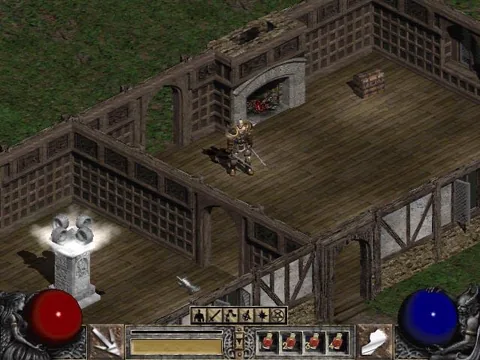
First you should look at the only surviving Guild Hall screenshot. Blizzard released it in November 1999 and it is essential viewing. It is also linked from the thumbnail further down this page. If you want more on Guild Halls — first-hand information from when we visited Blizzard North's offices in December 1999 — you are in luck. Click here for the detailed section on them in our long write-up of that visit. There is as much information there as on this page, so it cannot simply be quoted across.
As for the new screenshots, they are all exclusive and have never been shown anywhere. Thanks to Lanth for help in obtaining them.
2.1 Three New Images
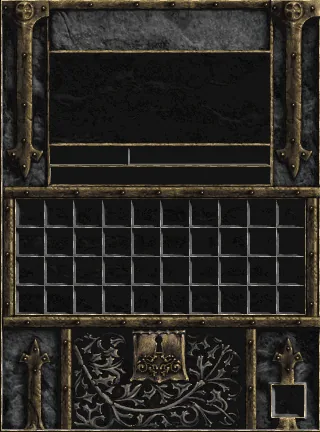
- The Guild Trophy Case — a place to display your best items, with a text description. It is not clear exactly how you would reach it from the Guild Hall. This is it, together with our mock-up of what it does.
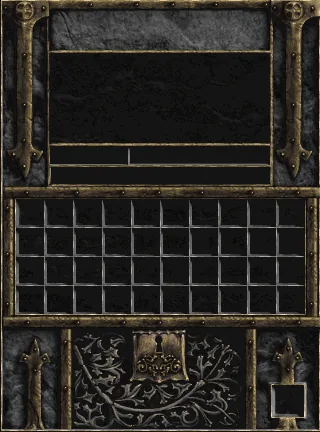
Mock-up interface:

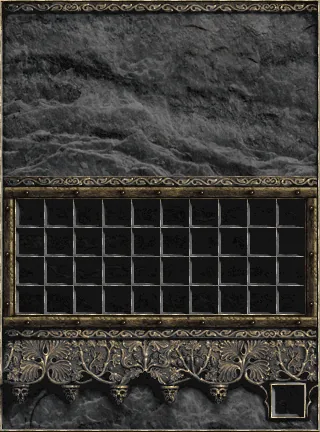
- The Guild Vault — a storage screen with 10×4 item slots, which you see when you click the storage box in the Guild Hall. This is it, together with our mock-up of what it does.
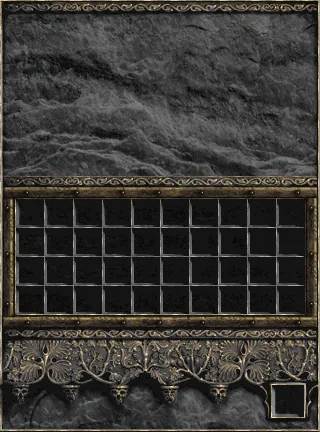
Mock-up interface:

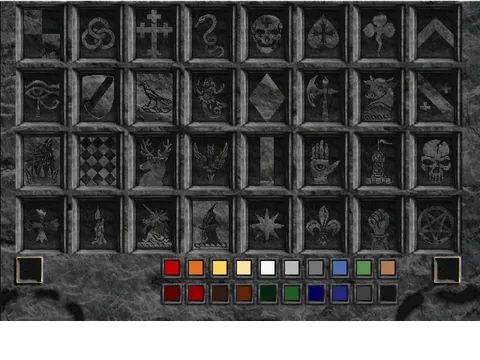
- The Guild Chevron Selection Page — possibly the most interesting of the three new images: it shows all the guild icons and colours you can choose from when representing your guild on Battle.net. This is it, together with our mock-up of what it does.
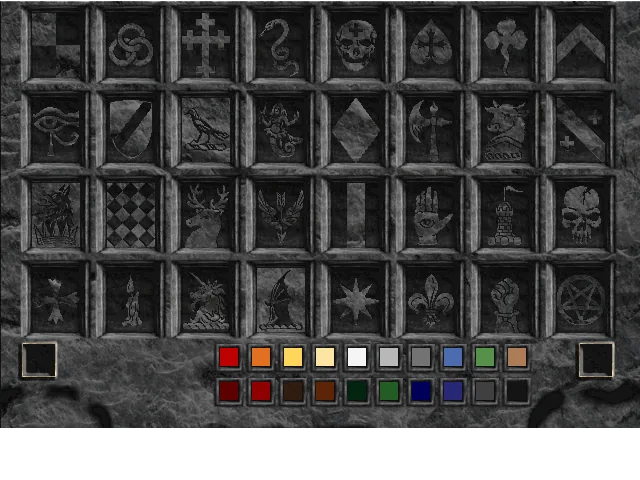
Mock-up interface:

2.2 Full Guild Hall Info
The text below the images on this page is an updated version of the pre-beta page — the last official word before Guild Halls were announced as cancelled. So if a shipping product does eventually include Guild Halls, the features listed here may (and probably will) change, but this is the freshest information we have.
People assumed Guild Halls would largely take shape during the beta: styles and ideas tried, then accepted or rejected partly on player feedback. That may still happen, depending on how large the Diablo II expansion beta is. With more time to think, though, Blizzard North may already have designed everything and need no public testing before adding it.
General Information
Here is a quick rundown of the most important features of the Guild Halls as we last knew them:
- A Guild Hall's "Steeg Stone": Guild Halls are free, and any character who has finished the game once can create one. [See the smoking altar in the lower left]
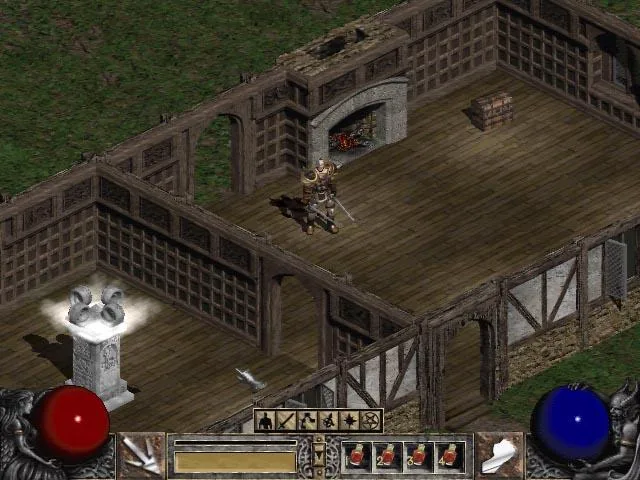
- Guild Halls exist only on Battle.net; owning one entitles you to choose a name, a three-letter abbreviation shown after every member's name, a two-colour scheme, and a "chevron" — the icon or symbol representing your guild.
- Guild Halls are absolutely safe. Anyone entering must first be added to the guild by the Guildmaster — a simple point, select option and click operation in Battle.net chat.
- The Guild Hall starts small: one room with outdoor grass you can romp around on. But as you drop money into the Steeg Stone (a kind of vault), it grows and gains more features.
- There is no set cap on guild membership, but it will be a large number — possibly a hundred or more.
Purpose
Guild Halls are part of the enhanced multiplayer experience Diablo II promised, added mainly for the popular player-run guilds and clans. Whether buying or upgrading, a Guild Hall certainly costs a great deal of money; it serves as a permanent private gathering place, probably with secure storage for a large number of clan members, and an open area for meeting, chatting and trading.
Purchase and Creation
The proposed Guild Hall system was fairly "theocratic": one character — the Guildmaster — leads. Whether that title could be transferred, or whether there was some kind of democracy (members could remove a sitting master when necessary), was never finalised.
Originally Blizzard North planned to require a very large amount of gold to create a Guild Hall, but early in 2000 they announced this had changed and Guild Halls would be easier to obtain — finishing the game once would let you create one.
Creation is simple: just select it as one of the options in the create-game menu reached from Battle.net chat. There is a "Guild Hall" option, and you choose to join or create just as you would a game.
The plan was that a character could belong to only one guild at a time, so presumably on creation your character gets a yes/no prompt about leaving the previous guild. What happens to belongings stored in the old Guild Hall — confiscated, lost forever, or appearing in the new one — was not known.
On creation the Guildmaster must set the guild name (almost certainly unique, first come first served), and may also set the guild tag: a three-letter (or shorter) [bracketed] abbreviation shown after every member's name. Whether tags were unique is unknown, but three letters = 26×26×26 = 17,576 combinations. That is quite a lot, yet with tens or hundreds of thousands of accounts and millions of characters per Battle.net server, any new guild would soon be stuck with tags like [QVY] — which is no fun.
Besides the tag, the guild insignia is also an option: chosen from a long list of heraldic designs. The guild's two-colour scheme could be set as well.
Blizzard North had talked about ranks inside a guild — so-called "Guild Lieutenants", members with more power than an ordinary member but less than the Guildmaster. A way for members to vote out a corrupt leader was also planned, and of course a way to pass the Guildmaster's mantle to another member. None of it had fresh news before Guild Halls were cancelled.
Security and Access
To enter a Guild Hall you select "Guild Hall" from the game selection menu, then choose "create" or "join"; if joining, you type your guild's name. If you type the name of a real Guild Hall, the Battle.net server checks whether your unique character ID# is on that hall's approved list. If it is, you appear on the Guild Hall map just as you would joining an ordinary Diablo game.
As far as we know, who can enter is entirely up to the Guildmaster. He can add names at any time, and presumably remove them, though we heard little about how kicking out bad members would work.
Other Features
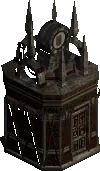
Only one Guild Hall image has ever been released, and you can see it here. It shows a lower-tier Guild Hall but not the starting tier, because the starting tier is a single room with no chest at all. As you drop more money into the Guild Hall's Steeg Stone, new things appear. The first upgrade was estimated at around 35,000 gold. What it adds is unknown, but a shared storage chest is most likely.
That figure is doubtful too, since it predates final game balance; and as we now know, 35,000 is not much at all in Diablo II — most characters have well over 100,000 gold by Act IV, and can earn more quickly if they want to.
Higher upgrades were meant to enlarge the hall and add other cool features, such as changing the map style, an in-guild bulletin board, and possibly even entering the Guild Hall directly from the game. Upgrades were said to cost more, but no figures were ever given. Money management would fall to the Guildmaster, since only he can use the vault and only he can click the Steeg Stone to see how much gold there is and how much the next level needs. Remember: all of these features were only planned and may change.
One heavily requested feature that never arrived was duelling or sparring inside the Guild Hall. It is mainly a technical problem: Guild Halls allow so many members that the server and every player's machine already have plenty to handle, and adding combat and spellcasting on top of standing around chatting would overwhelm most computers and badly hurt everyone's frame rate.
A nice and unexpected feature is the large outdoor area around the Guild Hall to play in. On joining a Guild Hall game you appear in a cul-de-sac and have to run right for a few seconds to reach the hall. In lower-tier Guild Halls the outdoor space is in the style of Act I wilderness, but whether higher tiers switch to Act II, Act III or another tileset is unknown.
Unresolved Issues
Since many things about Guild Halls are unknown or undecided, here are some of the leading questions about them:
- What happens if the Guildmaster removes a character from the access list? Is that character simply out, with no appeal? What happens to the items in his chest?
- Can the Guildmaster access every member's storage chest?
- What recourse do players have against a bad or unresponsive Guildmaster? Some limited form of democracy was mentioned, but how exactly would it work?
- Must you finish the game to join a Guild Hall too, or only to create one?
THE TRAVELLERS' LEDGER
The Travellers
These travellers have fed the campfire at Rogue Encampment.
List last updated · 2026-10-24 15:43
 *屑
Sponsored 2×
 *z
 *呀
 L*A
 *手
 *了
Sponsored 2×
 *铭
 *空
 p*e
 月*M
 T*g
 m*n
Support the Encampment
Support
Rogue Encampment is a cut-content archive I built out of respect for a great work and out of sheer love for it. Sorting material, researching cut content, restoring mechanics, keeping the site running — every part of it takes longer than farming Mephisto runs.
If you found something interesting here and would like to support me digging further, or simply feel like buying me a drink, you can add a log to the campfire and keep it burning.
Your support goes towards:
- Keeping the server and domain alive
- The time that goes into gathering material, research and video production
- A drink, or a hotpot
- My late-night and insomnia subsidy
Everyone who supports the camp gets written into the Travellers' ledger beside the campfire. Thank you!

中Keep it up!
中Thank you!
中Came from Bilibili. Love your videos — dense with information, sourced from the texts, and clearly made with real care.
中Thank you!